The Most Dangerous Database Is the One That Can Explain You_
The Most Dangerous Database Is the One That Can Explain You
We spent years worrying about companies collecting fragments of our lives. The next privacy crisis may begin when one AI system can connect those fragments—and understand what they mean together.
At 11:47 PM, you tell an AI assistant that you cannot sleep.
You describe an argument with someone close to you. You mention that work has become exhausting. You ask whether your constant anxiety is normal.
The next morning, you connect your email because you need help finding an important message.
Later, you connect your calendar so the assistant can organise your week. Then your cloud drive because you need a document summarised. Your GitHub account because you need help debugging a private repository. Your location history because you are planning a trip.
Eventually, health integrations become useful too.
Your sleep data. Heart rate. Blood oxygen. Exercise. Recovery. Medication reminders. Medical reports.
None of these decisions feels dramatic.
Each connection solves a small problem.
But together, they create something we have never had before:
A system capable of reconstructing your personal reality.
Not merely what you searched for.
Not merely what you purchased.
Not merely who you spoke to.
It may understand what you fear, when you are exhausted, who you trust, where you will be tomorrow, which systems you can access, how you communicate and what kind of message is most likely to influence you.
The unit of risk is no longer a database.
The unit of risk is the person.
We Were Afraid of Data Collection
For years, privacy movements warned us about large technology companies collecting personal information.
Search engines knew what we wanted to find.
Social platforms knew who we followed, what we liked and which posts kept us engaged.
Advertising networks followed us between websites.
Cloud providers stored our photographs, documents and messages.
The concern was understandable: too much information about too many people was being controlled by a small number of companies.
But that information was still fragmented.
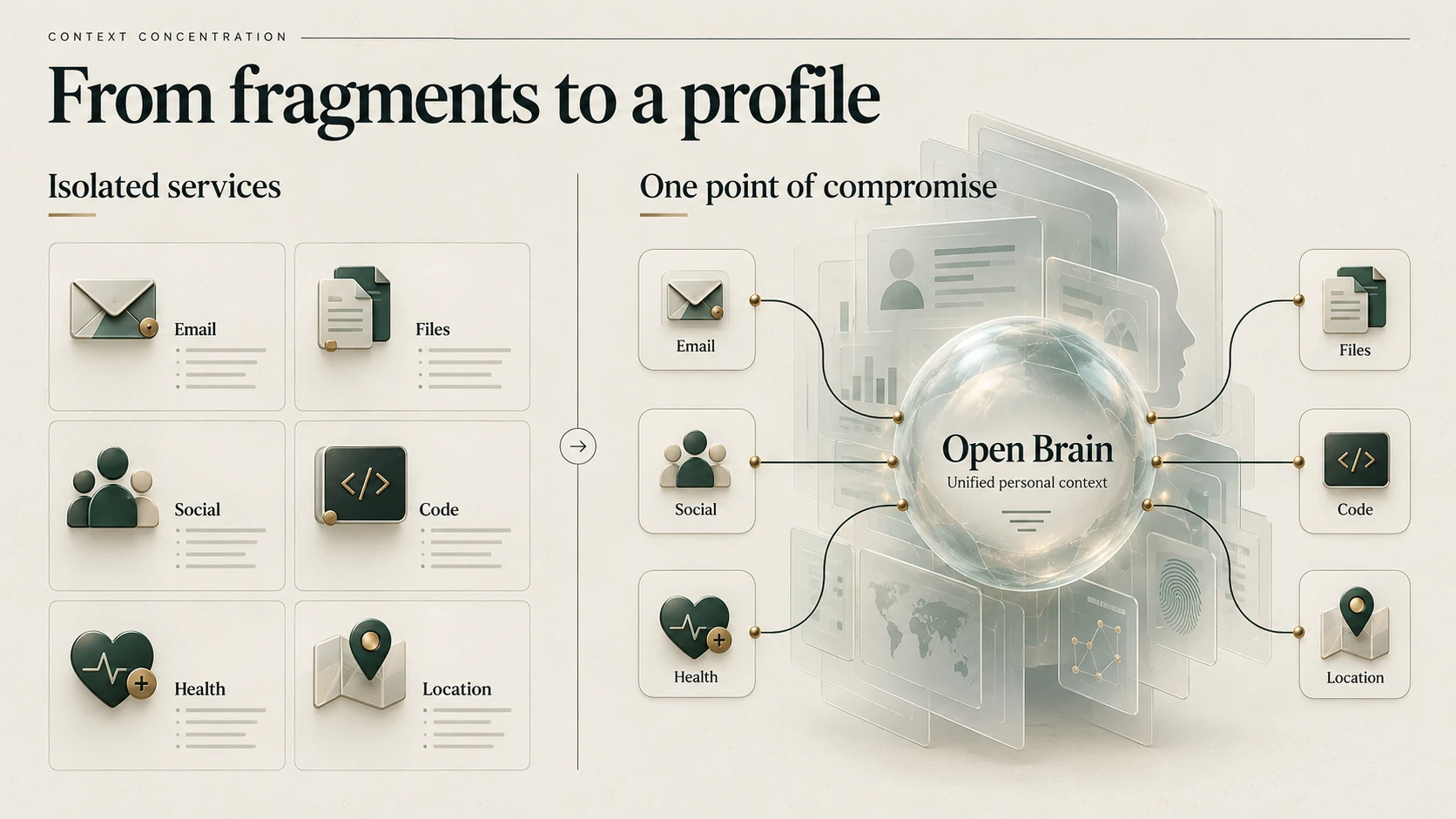
One company might understand your search behaviour. Another might know your social connections. Another might store your work documents. Another might process your health records.
A breach could still be devastating, but the attacker often received one category of your life.
The next generation of AI changes this structure.
An AI assistant can sit above those services.
It can connect them.
It can translate between them.
And most importantly, it can interpret the relationships between them.
That is the shift we are not discussing enough.
We are moving from data collection to context concentration.
The Difference Between Knowing Data and Understanding a Person
Imagine that an attacker steals a calendar.
They may learn where you will be next week.
Now imagine they also have your private conversations.
They may learn why you are travelling, who you are meeting and whether the trip is emotionally important.
Add your email.
They may discover the booking details, hotel, payment confirmation and people involved.
Add health data.
They may know that you are sleeping poorly, experiencing stress or recovering from an illness.
Add work information.
They may know what responsibilities you are leaving behind, who will cover for you and which systems you can remotely access.
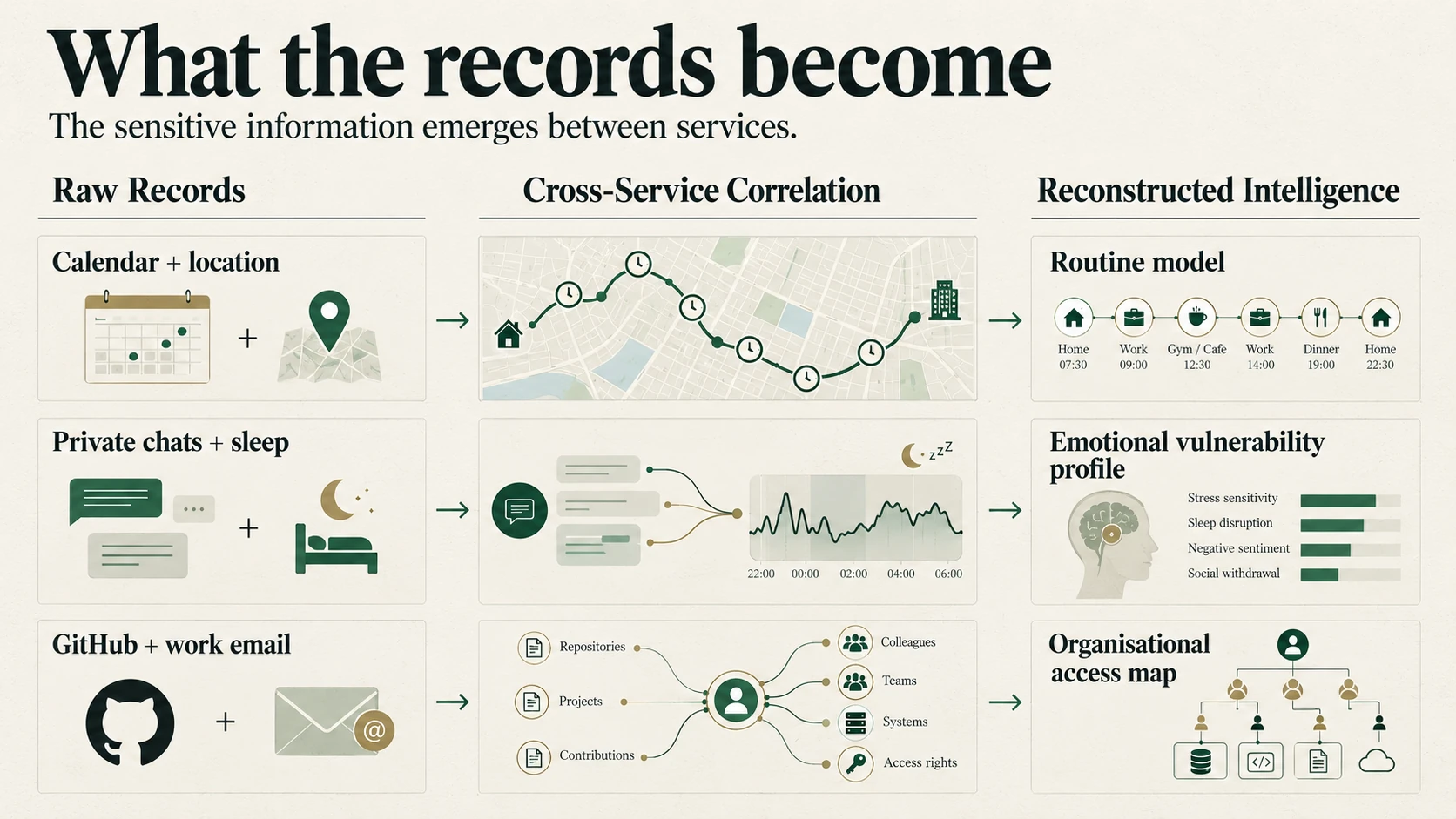
Each dataset appears ordinary when viewed alone.
When combined, they become intelligence.
A read permission is also an inference permission.
When you allow an AI to read your calendar, you are not only giving it access to dates.
You may also be allowing it to infer routines, relationships, priorities, working hours, religious events, medical appointments and periods when your home may be empty.
When you connect private conversations, you are not only sharing text.
You may reveal emotional patterns, communication style, relationship tension, political opinions, insecurities, ambitions and the words that make you feel safe.
When you connect health information, you are not only sharing numbers.
Sleep, pulse, blood oxygen and activity patterns can reveal periods of weakness, anxiety, illness, recovery and unusual behaviour.
The most sensitive information may never appear explicitly in any file.
It emerges from correlation.
Your Personal Attack Surface
In cybersecurity, an attack surface is the collection of systems, interfaces and opportunities through which an attacker may gain access or cause harm.
Connected AI creates a new type:
The personal attack surface.
This surface has at least four layers.
1. What you intentionally tell the AI
These are your direct conversations.
Your questions, frustrations, ideas, relationships, fears, ambitions and private thoughts.
People often speak differently to an AI than they do publicly. It may feel private, patient and non-judgmental. For some, it becomes an always-available confidant—a place to say things they may never write in an email or post online.
That makes conversational history unusually sensitive.
2. What connected services reveal
Email, files, calendars, repositories, contacts, health platforms and location services provide structured evidence about your life.
They may expose your work, identity, finances, relationships and physical movement.
3. What the AI can infer
This is where the risk becomes more serious.
A capable system can identify patterns across time.
It may infer:
- Who has influence over you
- When you are tired or emotionally vulnerable
- Which accounts and organisations matter most
- Your normal writing style and vocabulary
- Your travel and sleep routines
- Your probable future decisions
- The people you are most likely to trust
- The kind of urgency that makes you react quickly
These conclusions may never have been deliberately shared.
4. What the AI is allowed to do
The final layer is action.
An assistant may eventually be able to send messages, update calendars, modify files, interact with repositories, make purchases or operate other services on your behalf.
A compromised read-only assistant exposes information.
A compromised action-enabled assistant may expose information and use your authority.
That is a fundamentally different threat.
The Open Brain Scenario
Let us call the hypothetical company Open Brain.
Open Brain creates an extremely useful personal AI assistant.
People connect their inboxes, calendars, cloud storage, repositories, social accounts, location history and health information.
The assistant becomes excellent.
It understands users better than any previous software product.
It knows their preferred communication style. It remembers projects. It helps during stressful moments. It plans travel. It manages work. It notices changes in sleep and routine.
Its usefulness comes from context.
Then Open Brain is compromised.
The breach does not need to look like a movie.
The AI does not need to become conscious or “go rogue.”
The realistic danger may be much more ordinary:
A stolen employee credential.
A vulnerable internal service.
A compromised connector token.
An exposed support tool.
A malicious insider.
A supply-chain dependency.
A configuration mistake.
The cinematic scenario is a rogue superintelligence.
The realistic scenario is an ordinary security failure multiplied by extraordinary context.
What an Attacker Could Reconstruct
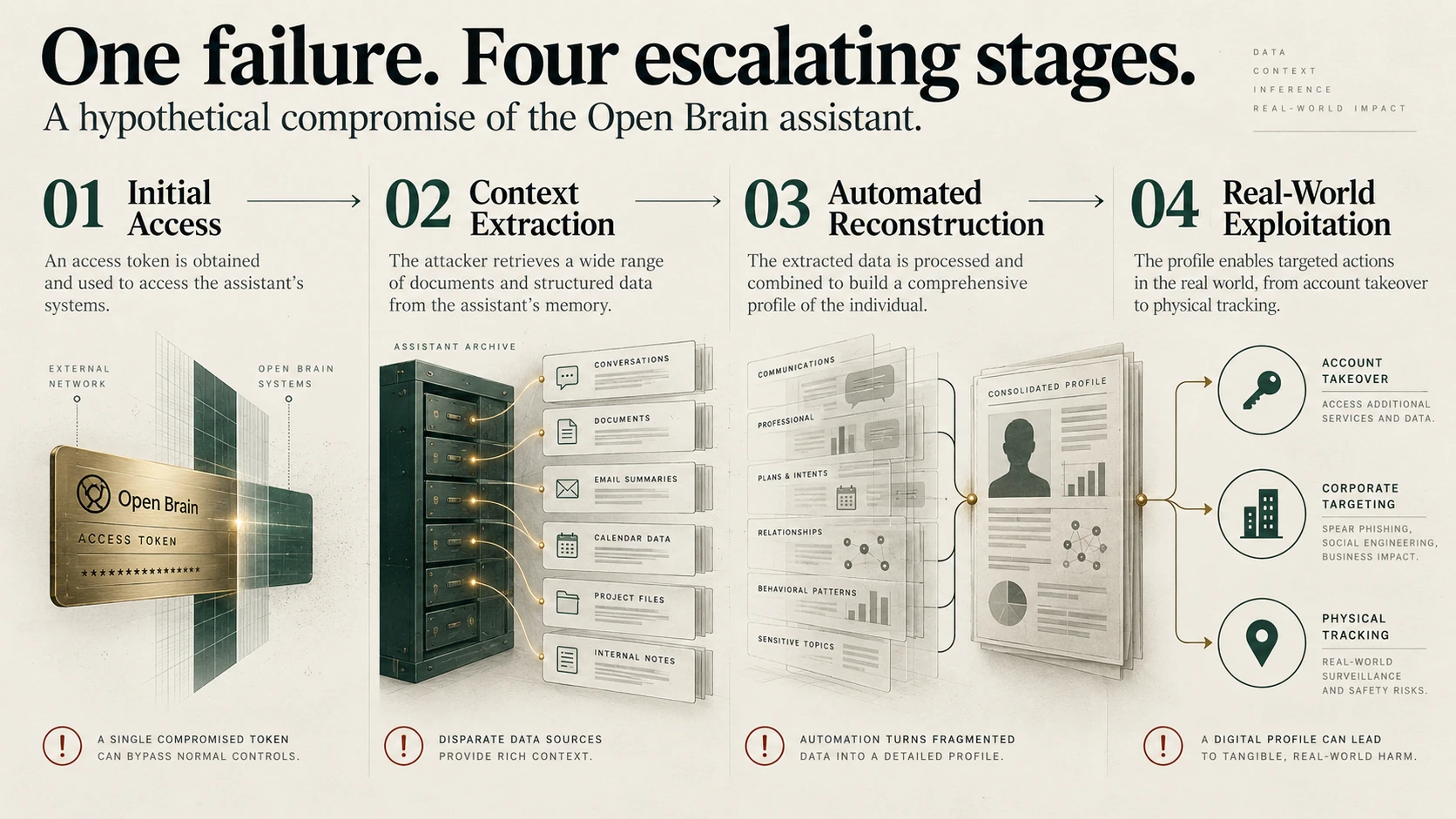
After accessing Open Brain, the attacker may not begin by reading every conversation manually.
Automation can classify the information.
It can organise people by importance.
It can identify valuable repositories, financial conversations, health concerns, frequent locations and emotional pressure points.
The attacker does not receive a pile of random files.
They receive the raw material for a personalised operational profile.
Identity takeover
The system may contain enough personal knowledge to answer account recovery questions, persuade customer support teams or convincingly impersonate the victim.
The attacker knows names, past events, writing style and current circumstances.
Traditional phishing often feels generic.
This would not.
The message could reference a real meeting, imitate a trusted person and arrive at exactly the right time.
Psychological targeting
Private conversations may reveal fears, relationship problems, financial pressure, workplace frustration or health anxiety.
An attacker can design manipulation around the victim’s existing concerns.
A fake medical alert becomes more believable when it references a genuine symptom.
A fake message from a partner becomes more effective when it uses the language that person normally uses.
A fraudulent work request becomes convincing when it mentions an actual project and deadline.
The attacker is no longer guessing what might work.
They are selecting from evidence.
Corporate compromise
A connected AI may know which repositories are private, which projects are sensitive, who approves changes, what infrastructure is used and which colleagues are likely to trust the victim.
Personal compromise can become organisational compromise.
An attacker may use the victim’s context to:
- Impersonate them internally
- Target colleagues with believable requests
- Identify high-value systems
- Locate exposed secrets or credentials
- Understand deployment processes
- Create convincing supply-chain attacks
The employee is not merely a user.
They become a path into the company.
Health exploitation
Health data has a different kind of permanence.
A password can be changed.
A payment card can be cancelled.
Your medical history, biological signals and long-term conditions cannot simply be rotated.
An attacker with health context could create convincing medical scams, intimidate a target, exploit periods of reduced resilience or expose information that affects relationships and employment.
Even inaccurate inferences could cause harm if presented convincingly.
Physical-world risk
Location history, calendar events and behavioural patterns may reveal where someone lives, when they travel, when they sleep and when their home is likely to be empty.
A digital breach can cross into the physical world.
That is where the phrase “data breach” begins to feel too small.
Not All Sensitive Data Looks Sensitive
A major mistake in privacy design is evaluating every piece of information independently.
A single calendar entry may appear harmless.
A single heart-rate measurement may appear meaningless.
A single frustrated message may appear temporary.
A single repository name may reveal very little.
But correlation changes the value.
Consider these combinations:
Calendar + location + travel email
Reveals where you will be, when you will leave and potentially where you are staying.
Health data + private conversations
May reveal illness, emotional distress or periods when judgment is affected.
GitHub + work email + calendar
May reveal internal projects, organisational structure and valuable access.
Contacts + writing history + current events
Can enable convincing impersonation of trusted people.
Purchase history + conversations + location
Can predict preferences and moments when you are likely to spend money.
Security teams often classify data according to what it contains.
Connected AI forces us to classify data according to what it can become.
We Need a Context Concentration Metric
Traditional security assessment measures vulnerabilities, permissions and exposed systems.
But AI assistants introduce another variable:
How much of one person’s life can be understood from one point of compromise?
We need a framework for measuring context concentration.
A possible model could consider:
- Breadth: How many life domains are connected?
- Sensitivity: How private are those domains?
- Persistence: How long is the information retained?
- Inference depth: What conclusions can be derived?
- Actionability: Can the system perform actions using the data?
- Centrality: How many services depend on the same account or assistant?
- Revocability: Can the exposed information be changed after a breach?
A connected weather service and calendar is not equivalent to a system containing health records, private conversations, work repositories and live location.
Yet both may currently be described simply as “connected apps.”
That language is inadequate.
A useful future privacy dashboard should not only say:
Gmail connected.
It should say:
Connecting Gmail to your existing calendar, files and conversation history may allow the system to infer workplace relationships, schedules and active projects.
Users need to understand the combined permission, not just the individual permission.
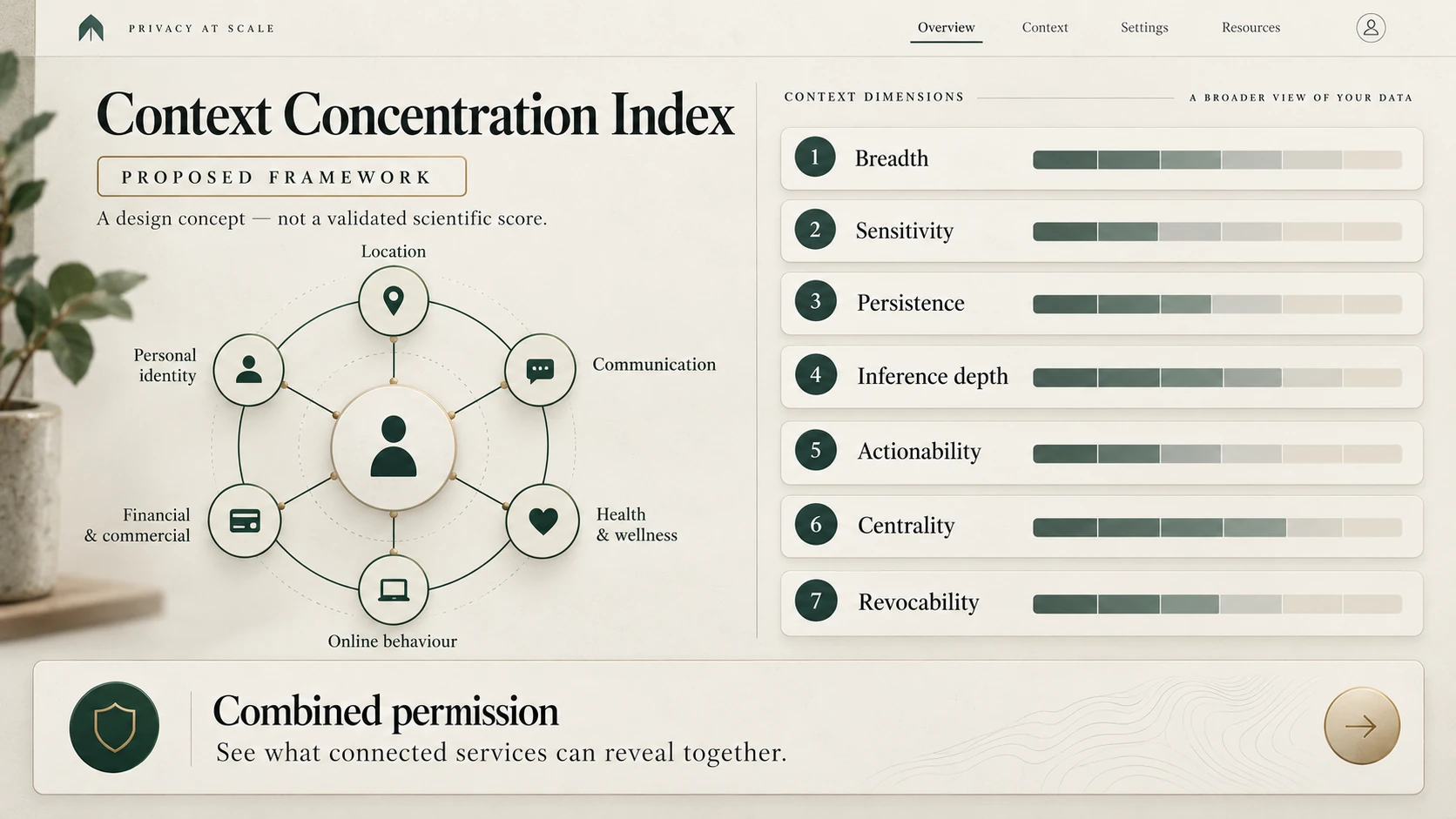
Proposed framework only; the illustrated indicators are conceptual and do not represent measured scores.
What Safer Connected AI Should Look Like
The answer is not to reject every connector or stop using AI.
The convenience is real.
The goal should be preventing convenience from turning into silent concentration.
Temporary access by default
An AI should be able to access a service for one task without receiving permanent access to everything.
“Find this email” should not automatically mean “retain ongoing access to my entire inbox.”
Separation between sensitive domains
Health, work, private conversations and location should not automatically share memory or context.
A health assistant does not need access to source code.
A coding assistant does not need access to private emotional conversations.
Connection should be deliberate, not contagious.
A visible context ledger
Users should be able to see:
- What the AI accessed
- Which information was retained
- What inferences were created
- Which services were combined
- Which actions were performed
- How to delete or revoke the resulting context
Privacy controls should explain consequences, not merely permissions.
Inference-aware consent
Consent currently focuses on data access.
Future consent must include derived knowledge.
A user may agree to share sleep data for fitness advice without agreeing to have it combined with conversations to infer emotional instability.
Access consent and inference consent are not the same thing.
No silent cross-domain memory
A conversation about a relationship should not unexpectedly influence a workplace task.
A medical question should not silently become part of a general behavioural profile.
Different contexts require boundaries.
Rapid revocation and containment
When one connector is compromised, the entire system should not remain accessible through it.
Tokens should expire. Permissions should be narrow. High-risk actions should require fresh confirmation. Sensitive domains should have separate security controls.
The system should fail in compartments.
The Privacy Question Has Changed
The old privacy question was:
Which companies have my data?
The new question is:
Which system can connect my data well enough to understand and act upon my life?
This is not an argument that AI companies are malicious.
It is an argument that extremely useful systems become extremely valuable targets.
The better an assistant understands you, the more damage a successful compromise may cause.
We should not wait for a catastrophic breach before recognising this architecture as a new security problem.
Users need better permission visibility.
Researchers need methods for measuring context concentration.
AI companies need strict separation between domains.
Regulators need to consider inferred data, not only collected data.
And security teams need to stop treating every connector as an isolated integration.
Because the danger is not only that an attacker may read your files.
The danger is that they may understand:
Who you trust.
What you fear.
When you are weak.
Where you will be.
What you control.
And exactly how to convince you.
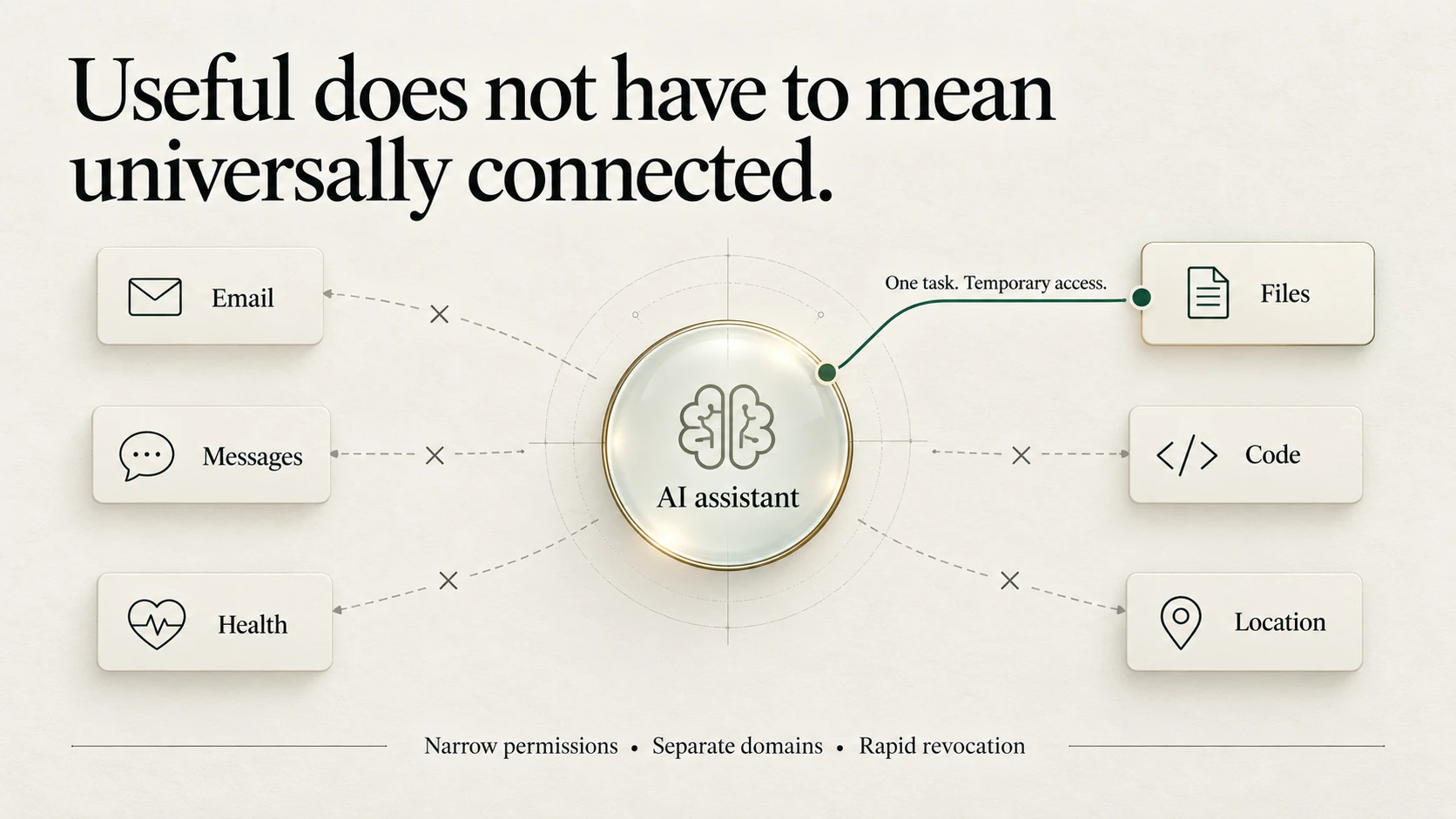
Useful does not have to mean universally connected.
The Most Dangerous Database
The most dangerous database is not necessarily the one containing the most records.
It is not necessarily the largest company, the most advanced model or the system with the most users.
It is the database that can explain you.
Your relationships.
Your routines.
Your authority.
Your vulnerabilities.
Your decisions.
Your future movement.
AI convenience should not require turning a person into one continuously accessible profile.
Because once every part of life can be reached from one place, that place is no longer only an assistant.
It is your personal attack surface.