Memory Hacks: Evidence-Based Strategies for Faster Learning and Retention_
Memory Hacks: Evidence-Based Strategies for Faster Learning and Retention
The science of learning has evolved dramatically over the past 150 years, moving from intuitive approaches to systematically validated techniques grounded in cognitive psychology and neuroscience. What separates learners who retain information for years from those who forget within days is not raw intelligence, but the strategic application of evidence-based memory techniques. This report synthesizes the strongest scientific findings on memory retention and learning acceleration into actionable frameworks you can implement immediately.
The Foundation: Understanding How Memory Actually Works
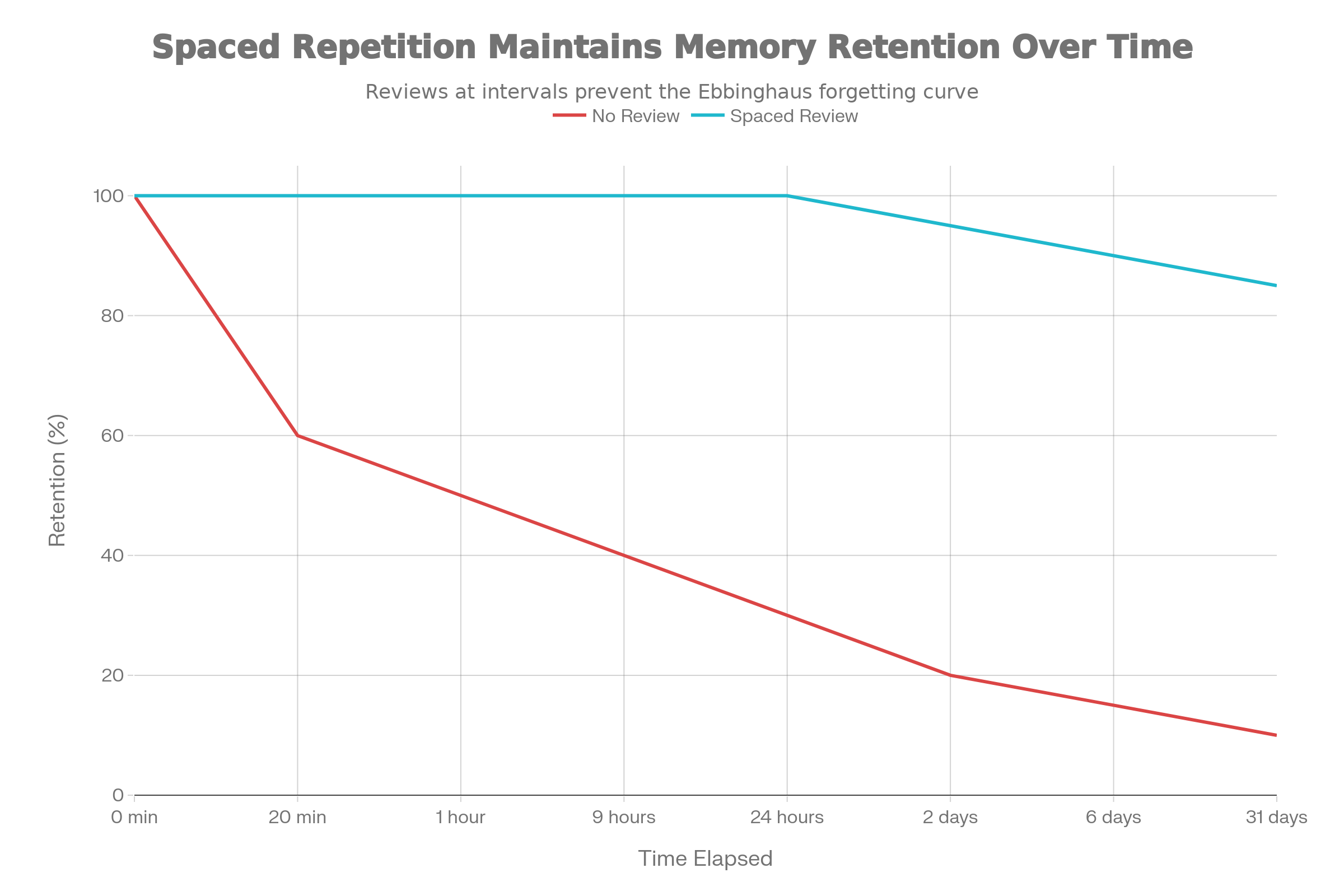
Your brain doesn't store memories like a computer saves files. Instead, each time you recall information, you physically strengthen neural connections—a process called reconsolidation. This fundamental principle underlies every effective memory technique discussed below. Without retrieval practice, your brain naturally discards information to conserve resources, a phenomenon first documented by Hermann Ebbinghaus in the 1880s through his "forgetting curve."
Research shows that without strategic review, you lose approximately 70% of newly learned information within the first 24 hours. However, this is not inevitable—the forgetting curve can be dramatically flattened through precise intervention timing.
Core Technique 1: Spaced Repetition—The Most Powerful Learning Multiplier
Spaced repetition is the single most evidence-backed memory technique, producing consistently superior results across domains from vocabulary learning to medical education. The mechanism is straightforward: instead of reviewing material in one cramming session, you review at strategically expanding intervals just as you're about to forget.
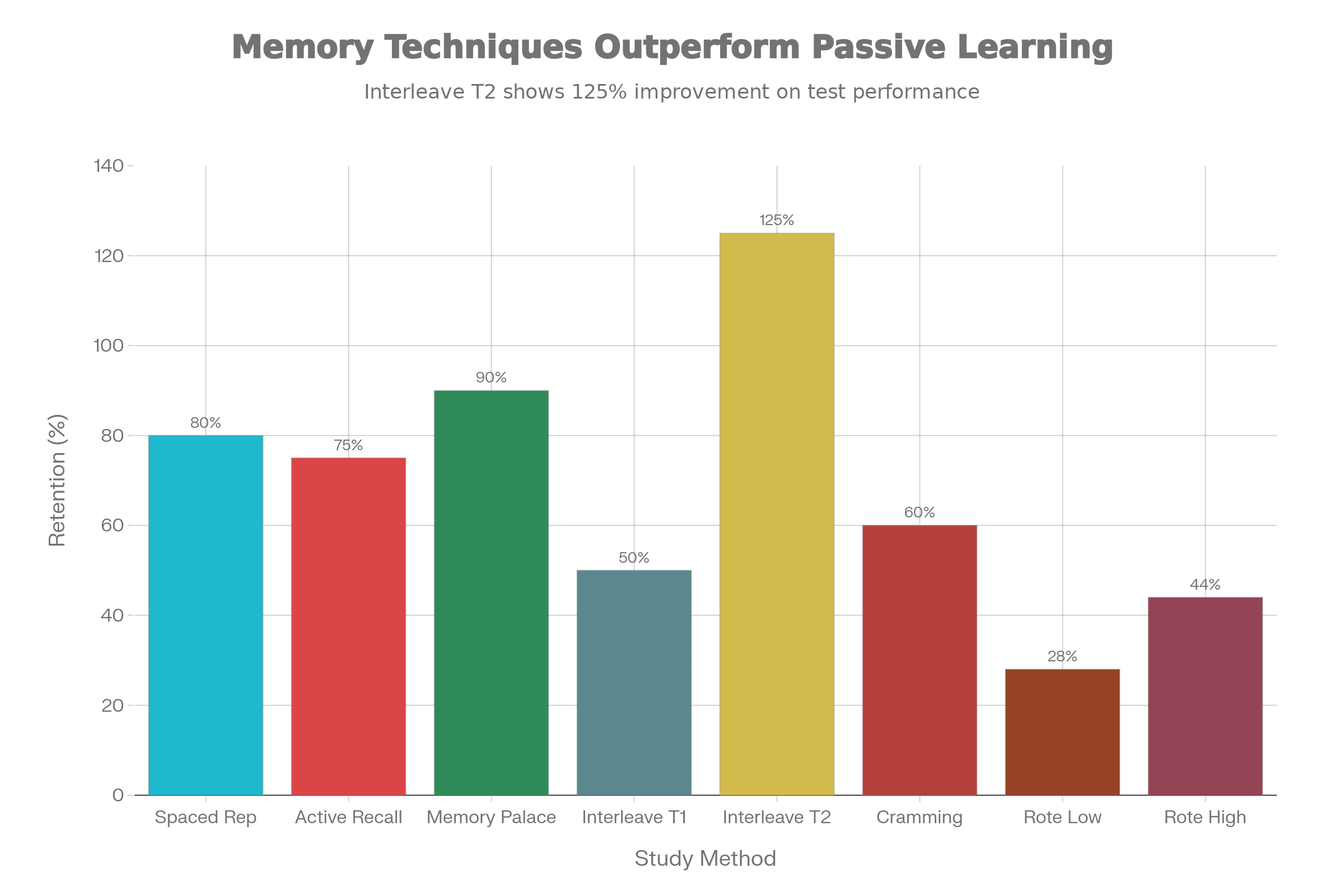
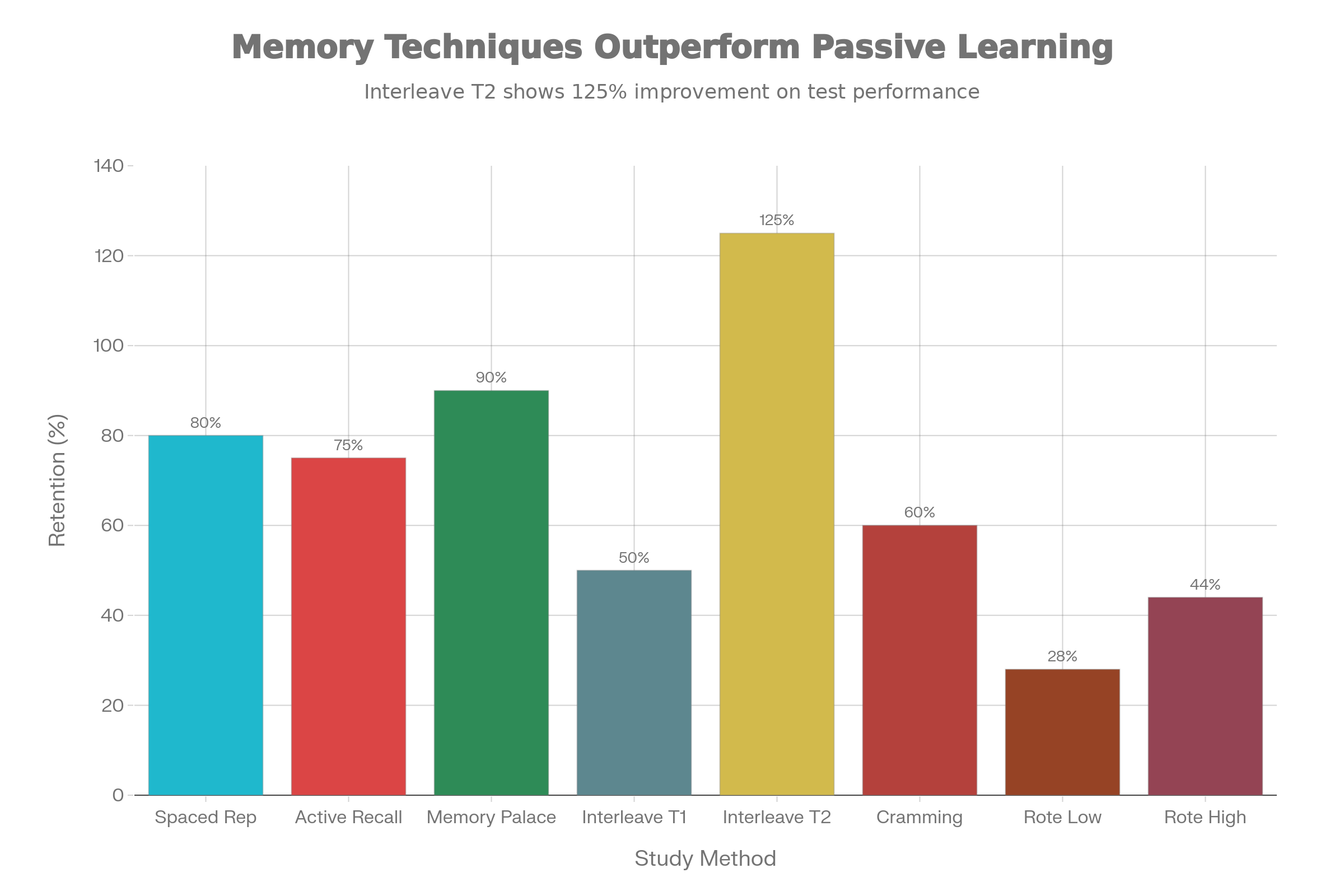
A meta-analysis from the Journal of Experimental Psychology demonstrated that students using spaced repetition achieved 80% recall accuracy compared to just 60% for those who crammed. In medical education specifically, students using spaced repetition scored an average of 88% on tests versus 78% for traditional studying. More impressively, research from medical education found that reviewing material within 24 hours increases retention by up to 80%.
The Optimal Review Schedule
Ebbinghaus's original research identified intervals that remain optimal today:
- First review: 20 minutes after initial learning
- Second review: 1 hour later
- Third review: 9 hours later
- Subsequent reviews: 1 day, 2 days, 6 days, 31 days
Each review session strengthens the memory trace, extending the interval before the next review becomes necessary. The key insight is that reviews should occur at the point where memory is beginning to fade but before complete forgetting occurs—this forces your brain to engage in retrieval, which is the actual mechanism of learning, not exposure to information.
Implementation: Anki and Spaced Repetition Software
The open-source software Anki automates spaced repetition using algorithms based on decades of research (SM-2 algorithm or the newer FSRS algorithm). Anki presents flashcards at precisely calculated intervals based on your individual performance, handling the scheduling complexity automatically. For professionals learning technical material, domain-specific vocabulary, compliance frameworks (ISO, NIST, SOC 2), or cybersecurity concepts, Anki eliminates guesswork about when to review.
Core Technique 2: Active Recall—The Testing Effect
The single most underutilized learning technique is active recall: testing yourself on material before you feel ready. Passive review methods—re-reading notes, highlighting, watching videos—are ranked as low-utility strategies by cognitive science. Yet these remain the default study approach for most learners.
Active recall works through what researchers call "the testing effect." When you force your brain to retrieve information from memory, you create stronger, more lasting memories than when you passively review the same material. A comprehensive 58-page meta-analysis concluded that active recall (termed "practice testing") is a high-utility learning technique with robust empirical support. Students using active recall consistently score higher on exams than students using passive review methods, even when total study time is identical.
Why This Contradicts Intuition
Active recall feels harder than passive review—a phenomenon called "desirable difficulty." During a study session using active recall, you may feel like you're learning less because you struggle with questions. Research on interleaving (mixing topics) shows that learners systematically underestimate how much they learn from difficulty: they rate blocked practice (easier) as more effective than interleaved practice (harder), even though interleaving produces dramatically better long-term retention.
Implementation: Self-Testing Strategies
Transform passive note review into active retrieval:
- Cover your notes and write down everything you remember
- Create practice questions based on your material and quiz yourself
- Use the Leitner system: physically separate flashcards into "knows," "partly knows," and "doesn't know" piles, reviewing harder piles more frequently
- Take pre-tests on material you're about to study (research shows this primes your brain and improves subsequent learning even on initially wrong answers)
Core Technique 3: Memory Palace (Method of Loci)—Spatial Encoding
The memory palace technique, used by Roman orators 2,000 years ago and by contemporary memory champions today, leverages a unique strength of human cognition: spatial memory. Your brain is inherently wired to remember places and spatial relationships. This technique associates information with specific locations in an imagined familiar space (a palace, your home, a street).
Neuroimaging research reveals that the memory palace method engages multiple brain regions simultaneously: the medial parietal cortex (encoding/retrieval), retrosplenial cortex (spatial awareness), and right posterior hippocampus (memory). This multi-system activation creates redundant retrieval pathways, explaining why this ancient method remains effective.
Effectiveness Evidence
Studies show memory palace practitioners achieve retention rates of 88-93% compared to 28-44% for rote learning. The technique excels specifically for sequences, large datasets, numbers, and information requiring specific ordering. Memory champions use this technique to memorize thousands of digits or the order of shuffled decks of cards.
How to Build a Memory Palace
- Choose a familiar location: Your home, a regular walking route, or your workplace
- Create a mental journey: Mentally walk through this space in a consistent order
- Convert information to visual symbols: Transform abstract concepts into vivid, unusual images (the more bizarre or emotional, the better—your brain encodes distinctive images more strongly)
- Place symbols at specific locations: Position each image at a specific point in your journey
- Review by mentally retracing your steps: Walk through the palace and retrieve the information
For example, if learning cybersecurity vulnerability types, you might imagine SQL injection attacks as "injected syringes attacking a server in your home's front door," cross-site scripting as "scripts crawling up your living room walls," and CSRF as "fake credit cards on your desk."
Core Technique 4: Interleaving—Mixed Practice for Deeper Learning
Interleaving refers to mixing different topics or problem types during practice, rather than practicing one topic completely before moving to the next (blocked practice). This technique produces counterintuitive results: it feels harder during practice but produces dramatically better learning.
Research in undergraduate physics found that students completing interleaved homework achieved median improvements of 50% on the first surprise test and 125% on a second test, despite initially rating the interleaved assignments as more difficult. The effect is comparable across domains from mathematics to language learning.
Why Interleaving Works
Interleaving forces your brain to:
- Retrieve multiple strategies rather than repeatedly using the same solution
- Discriminate between concepts by forcing direct comparison of similar ideas
- Adapt strategy selection to varying problem contexts, simulating real-world unpredictability
When material is blocked (all Topic A, then all Topic B), learners can bypass memory retrieval entirely—they simply apply the same formula repeatedly. This feels efficient during practice but produces poor long-term retention. Interleaving prevents this cognitive shortcut by forcing constant retrieval and strategy selection.
Implementation for Technical Learning
Instead of studying all NIST compliance requirements, then all ISO controls, then all SOC 2 requirements, mix them throughout your study. Create practice scenarios that require you to identify which framework applies, forcing deeper conceptual discrimination.
Sleep and Memory Consolidation—Non-Negotiable Neurobiology
Sleep is not optional for learning; it is the biological mechanism through which memories are transformed from fragile, short-term states to robust, long-term storage. During sleep, your brain undergoes "systems consolidation"—memories initially stored in the hippocampus are reorganized and integrated into cortical networks for permanent storage.
Research demonstrates that sleep following learning improves retention far more than equivalent waking time. This effect is independent of fatigue, circadian rhythms, or time of day—the neural processes of sleep specifically enhance memory consolidation. The mechanisms involve slow-wave sleep (which strengthens neural representations) and REM sleep (which refines and integrates memories), with sleep spindles (brief bursts of neural activity) serving as markers of consolidation strength.
The Timing Advantage
Studies with high school students learning vocabulary showed that retention was significantly better when sleep occurred soon after learning, and this benefit persisted for 48+ hours. The implication: intensive learning followed closely by sleep produces superior retention to the same learning spread across waking hours.
Practical Application
For maximum learning efficiency: conduct focused study sessions in the afternoon/evening, then sleep that night. Avoid late-night cramming—the sleep that follows cramming occurs after the "critical window" for consolidation has passed, and sleep deprivation itself impairs memory function. A 20-minute afternoon nap can also boost subsequent learning by allowing partial consolidation.
Supporting Technique 1: Chunking—Managing Cognitive Load
Working memory—the mental "workspace" where thinking occurs—has severe capacity constraints. Miller's classic research established that working memory can hold approximately seven chunks of information, and can only actively process about four. When learners are presented with too much information too quickly, cognitive overload occurs, learning breaks down, and new information never reaches long-term storage.
Chunking directly addresses this limitation by breaking complex information into logically related, smaller units. A phone number (0412345678) becomes manageable when chunked (0412 345 678). Similarly, complex compliance frameworks become learnable when divided into logical sections rather than presented as overwhelming wholes.
Cognitive Load Theory Framework
Cognitive load theory, developed by John Sweller, explains that learning is optimal when presented information stays within working memory capacity. When chunking is combined with spaced repetition, each chunk is reviewed at optimal intervals before it can be forgotten, ensuring transfer to long-term memory while preventing cognitive overload during the initial encoding phase.
Implementation Strategy
- Divide complex topics into 3-5 core concepts
- Present one chunk, then pause for retrieval practice before introducing the next
- Use visual aids (mind maps, concept diagrams) to help learners self-chunk information
- Pace learning: introduce one chunk, allow active recall practice, then introduce the next chunk
Supporting Technique 2: Elaborative Encoding—Creating Meaningful Connections
Elaborative encoding describes the cognitive process of relating new information to existing knowledge, experiences, or emotional associations. This creates multiple retrieval pathways—when you remember one fact, it can trigger recall of related facts through association.
Recent research comparing elaborative encoding strategies with retrieval practice found that elaborative encoding tasks like interactive imagery (imagining scenes) and sentence generation produced equal or superior retention compared to retrieval practice alone. The power of elaboration lies in creating distinctive, multi-sensory mental representations.
Elaboration Techniques
- Interactive imagery: Create vivid mental scenes connecting new information to familiar contexts (e.g., imagining a "firewall" as an actual wall of fire protecting a server)
- Sentence generation: Write sentences that meaningfully connect new concepts to existing knowledge
- Link system: Create narrative chains linking sequential items through interactive stories
- Personal relevance: Explicitly connect material to your professional goals, past experiences, or current projects
For cybersecurity learners, connecting "Zero Trust" to your personal device security practices, or "ECDSA encryption" to specific use cases you encounter, creates stronger encoding than memorizing definitions.
Supporting Technique 3: Cornell Note-Taking—Structured Active Encoding
The Cornell Note-Taking System, developed in the 1950s at Cornell University, structures notes to promote active engagement rather than passive transcription. The system divides a page into three sections:
- Note-taking column (right, 2/3 of page): Main ideas, paraphrased information, key points using abbreviations
- Cue column (left, 1/3 of page): Questions, keywords, and prompts—added after the lecture/reading by reviewing the right column
- Summary section (bottom, 1/5 of page): One-sentence summary of the page's main point
The system's power lies in the cue column creation process: converting notes into questions forces active processing and creates natural retrieval practice prompts. When reviewing, students cover the right column and attempt to answer cue column questions, using the answers as feedback.
The "5 Rs" Review System
Cornell notes incorporate a systematic review protocol:
- Recite: Answer cue column questions aloud from memory
- Reflect: Think about how concepts relate to prior knowledge
- Review: Scan notes and summaries regularly
- Repeat: Return to material periodically (aligned with spaced repetition intervals)
- Relate: Explicitly connect material to applications and real-world situations
Optimizing Study Sessions for Peak Performance
Attention span research reveals that the human brain naturally cycles through periods of focus and fatigue. On average, people can concentrate deeply for 25-45 minutes before mental fatigue requires a break. Beyond this window, focus deteriorates unless a rest period occurs.
The Pomodoro Technique and Extensions
The standard Pomodoro technique (25 minutes focus + 5 minute break) aligns with natural attention cycles. For longer learning sessions, the technique scales: 50 minutes work + 10-15 minute break, or 90 minutes work + 20 minute break. Critically, breaks must be genuine breaks—no phone, no work-adjacent tasks—to allow neural recovery.
Optimal Timing for Learning
Research shows the brain exhibits peak alertness during specific windows:
- 10 am - 2 pm: Peak analytical thinking and information integration
- 4 pm - 10 pm: Good for learning (but potentially affected by afternoon fatigue)
- 4 am - 7 am: Optimal for deep focus and complex learning
Quality dramatically outperforms quantity: a sharp, focused 2-hour session produces more learning than a distracted 6-hour marathon.
Developing Metacognition—The Meta-Skill of Learning
Metacognition—awareness and regulation of your own thinking—is the master skill underlying all effective learning. Strong metacognitive ability means you accurately know what you know, what you don't know, and can select appropriate learning strategies.
Ironically, learners often lack metacognitive awareness of the most effective techniques. Research on pretesting showed that even after repeated experience with the pretesting effect, many learners remained unaware of its superiority over traditional study—they continued predicting lower performance for pretested material. This gap between actual effectiveness and perceived effectiveness creates a critical barrier: learners won't spontaneously use powerful techniques they don't believe work.
Building Metacognitive Awareness
- Collect performance data: Track which techniques produce the best test results for you, not which feel most productive
- Seek external feedback: Compare your predictions of test performance with actual scores
- Use low-stakes quizzing: Frequent, ungraded self-tests reveal knowledge gaps that studying obscures
- Reflect on strategy effectiveness: After each learning session, ask: "Did I understand something new? Could I solve problems without looking up answers?"
Integration: A Complete Learning System
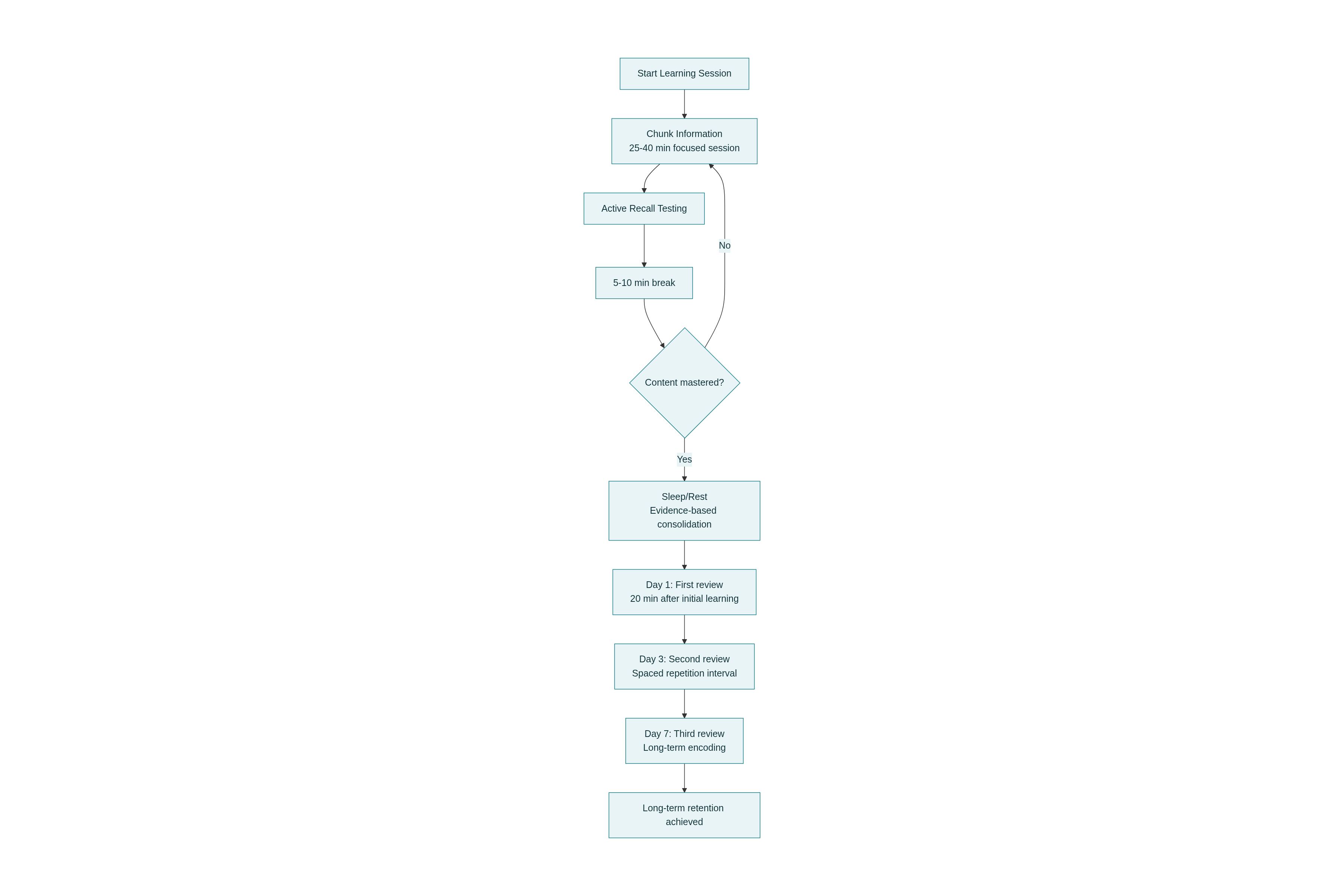
The most effective learning combines multiple techniques rather than relying on any single approach. Here's how the evidence-based system integrates:
Daily Learning Workflow:
-
Planning Phase: Chunk your learning material into 3-5 core concepts (reduce cognitive load)
-
Active Learning Session (25-40 minutes):
- Study one chunk using elaborative encoding (relate to existing knowledge, create distinctive mental images)
- Take Cornell notes to structure information and create retrieval cues
-
Immediate Active Recall (5 minutes):
- Cover notes and write down everything you remember
- Use retrieval cues from the cue column to test yourself
-
Break (5-10 minutes): Allow neural recovery before the next chunk
-
Sleep: Cognitive consolidation occurs during sleep—study in afternoon/evening, sleep that night
-
Spaced Review Schedule:
- Day 1: 20 minutes after learning (in the same session) + review that evening
- Day 2: Brief 5-10 minute review
- Day 1 - Week 1: Review at expanding intervals (daily, then every 2-3 days)
- Week 2+: Space out to weekly or monthly reviews based on Anki's algorithm
-
Interleaving (once multiple topics mastered): Mix topics in practice problems rather than blocking by topic
Tools and Practical Resources
Spaced Repetition Software:
- Anki (free, open-source): Most powerful for technical material; steep learning curve but unmatched for complex domains
- Brainscape, Quizlet: User-friendly alternatives; shared decks accelerate learning
- Mnemosyne: Lighter-weight alternative using similar algorithms
Note-Taking and Organization:
- Cornell template files: Available in GoodNotes, OneNote, or create manually on paper
- Mind mapping tools: XMind, MindMeister, or Obsidian for elaboration-based note-taking
- Spaced Repetition + Note Integration: Obsidian Spaced Repetition plugin links notes with review scheduling
For Compliance and Technical Learning:
- Create Anki decks with compliance framework mappings (NIST controls, ISO requirements, SOC 2 criteria)
- Build memory palaces for regulatory timelines, control sequences, or threat intelligence taxonomies
- Use interleaved practice: Create scenarios mixing frameworks rather than studying one at a time
Addressing Common Pitfalls
Mistake 1: Confusing Recognition with Recall
When reviewing highlighted notes, you experience recognition—the information seems familiar. This creates an illusion of learning. Actual learning requires recall: retrieving information from memory without external cues. Always test yourself without looking at material.
Mistake 2: Underestimating the Value of Spacing
Compressed schedules tempt learners to mass practice. Research is unambiguous: compressed practice (massed learning) produces short-term improvements but dramatically worse long-term retention. Review intervals matter more than total review time.
Mistake 3: Ignoring Sleep
Late-night cramming sacrifices the neural consolidation that occurs during sleep. A 7-hour sleep post-learning produces better retention than 12 hours of additional waking study.
Mistake 4: Avoiding Difficulty
Techniques that feel harder during practice (interleaving, elaborate generation) are more effective for long-term learning. Difficulty during practice signals effective learning, not ineffective studying.
Practical Next Steps
-
Week 1: Establish the foundation
- Choose material to learn (compliance framework, programming concept, professional domain knowledge)
- Create an Anki deck or use Cornell notes to structure material into chunks
- Perform one active recall session daily
- Sleep immediately after learning
-
Week 2-3: Implement spaced repetition
- Review Day 1, 3, 7, 14, 30 using active recall
- Track which techniques produce highest test performance
- Develop metacognitive awareness: compare predicted vs. actual performance
-
Week 4+: Integrate advanced techniques
- Add elaborative encoding: relate material to your projects and professional goals
- Implement interleaving if studying multiple related topics
- Consider memory palace for complex sequences or large datasets
- Adjust spacing intervals based on personal performance data
Conclusion
The gap between efficient and inefficient learners is not innate ability but systematic application of evidence-based techniques. The research is clear: spaced repetition produces 80% retention vs. 60% for cramming; active recall outperforms passive review; sleep is essential for consolidation; and metacognitive awareness drives continued improvement.
For professionals in cybersecurity, compliance, data analysis, and other technical domains requiring rapid mastery of complex material, these techniques represent a force multiplier on learning capacity. Implementing even two or three of the core techniques—spaced repetition combined with active recall plus strategic sleep—produces measurable, substantial improvements in retention and performance.
The evidence suggests that time invested learning how to learn efficiently produces far greater returns than additional time spent learning using inefficient methods. Begin with spaced repetition and active recall; add elaborative encoding and proper spacing; and you will transform your learning trajectory.