Artificial Intelligence Timeline: From a Single Neuron to Models That Can Think_
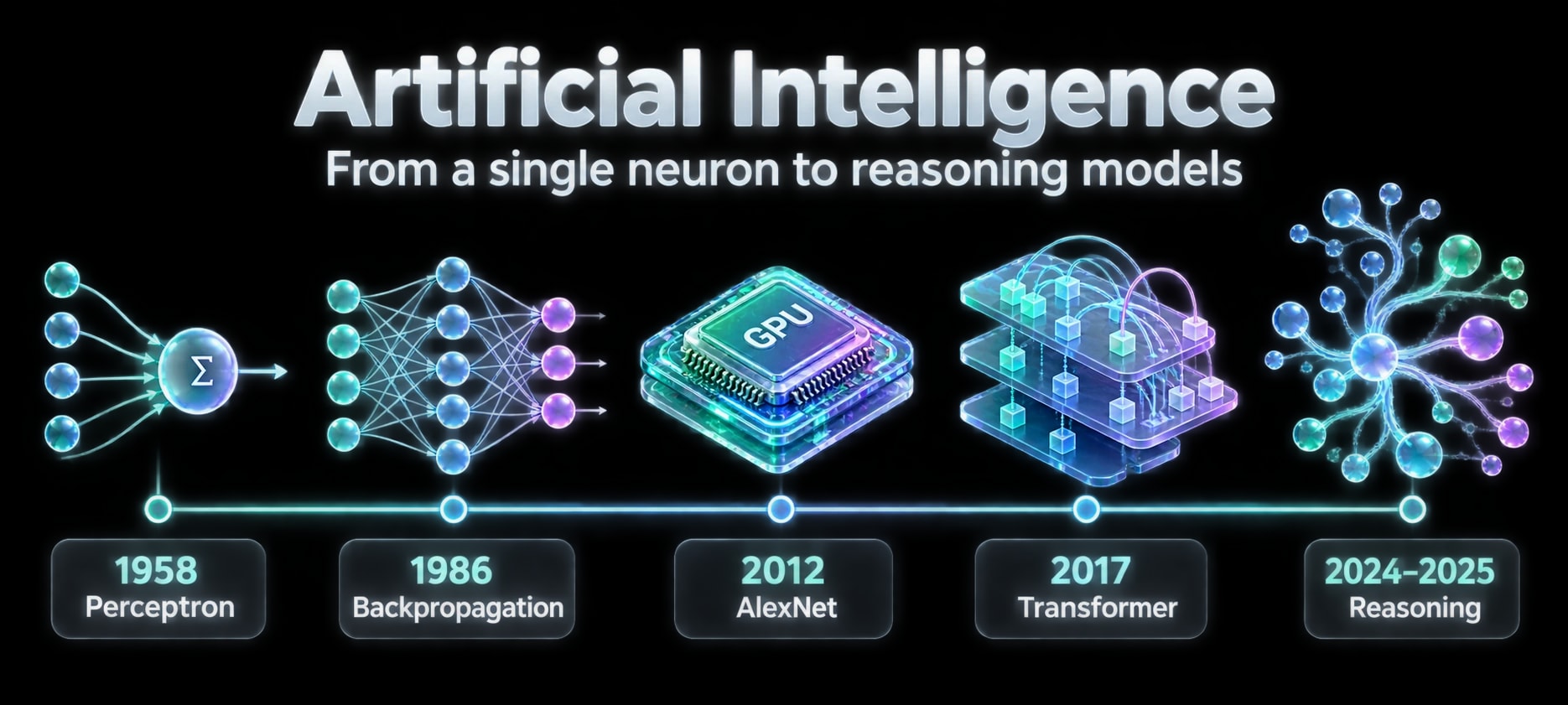
Artificial Intelligence Timeline
From a Single Neuron to Models That Can Think
No hype. No buzzwords without explanations. Just the actual story of a how we got here - paper by paper, breakthrough by breakthrough.
The Problem AI Is Actually Solving
Before anything else, let's cut through the noise.
AI is not about making machines "smart." It's about solving one very specific computational problem:
Can a machine learn patterns from data - without being explicitly programmed for every case?
Traditional software: you write rules. "If X, then Y." Every case handled manually.
Machine learning: you give it examples. The machine finds the rules itself.
That's the whole game. Everything else - neural networks, transformers, ChatGPT, Claude - is just increasingly clever engineering to solve that one problem better.
1958 - The Perceptron: Proof That Machines Can Learn
Frank Rosenblatt, 1958 The Perceptron: A Probabilistic Model for Information Storage and Organization in the Brain - Psychological Review
The first crack. Rosenblatt built a mathematical model of a single neuron. Here's how it worked:
- Take some inputs (say, pixel values of an image)
- Multiply each by a weight (how important is this input?)
- Sum them all up
- Output a decision: yes or no
The magic part - the learning rule: if the answer is wrong, nudge the weights slightly. Repeat across many examples. The machine adjusts itself.
That's genuinely new. A machine that corrects itself from mistakes.
The catch? A single perceptron can only solve simple, linearly separable problems. It completely fails at XOR - a basic logic problem where you need "either A or B but not both." Researchers proved this in 1969, funding dried up, and we hit the first AI Winter. Years of stalled progress.
But the principle was proven: learning is possible.
1986 - Backpropagation: Teaching Deep Networks to Learn
Rumelhart, Hinton & Williams, 1986 Learning Representations by Back-Propagating Errors - Nature, Vol. 323
Stack multiple perceptrons in layers and you get a neural network - capable of solving complex problems the single perceptron couldn't. But there was a brutal new problem:
When the network gets the answer wrong, which layer's weights do you blame? How do you assign credit?
This is called the credit assignment problem.
The answer - backpropagation - is just calculus applied cleverly. The chain rule, specifically.
Here's the mechanic:
- Feed data forward through the network → get an output
- Compare to the correct answer → calculate the loss (how wrong were we?)
- Work backwards through each layer - calculate how much each weight contributed to the error
- Nudge each weight in the direction that reduces the error (Gradient Descent)
- Repeat millions of times
This solved the credit assignment problem. Networks with multiple layers - deep networks - could now learn.
But two new problems appeared:
- Vanishing gradients - In very deep networks, the error signal gets weaker as it travels backward through layers. By the time it reaches early layers, the gradient is nearly zero. Nothing learns.
- Compute - Training even shallow networks on real data was painfully slow on 1980s hardware.
So the idea mostly sat. For a while.
1997 - LSTMs: Giving Networks a Memory
Hochreiter & Schmidhuber, 1997 Long Short-Term Memory - Neural Computation, Vol. 9
Before this, the field tried Recurrent Neural Networks (RNNs) for sequences - language, speech, time series. The idea was elegant: process one step at a time, carry a hidden state forward as memory.
But vanishing gradients destroyed them. In a 100-word sentence, backpropagating through 100 time steps meant multiplying gradients 100 times. They vanished. The network effectively forgot anything from more than ~10 steps back.
LSTM fixed this with a brilliant architectural trick: instead of one hidden state, give the network an explicit cell state - a conveyor belt that carries information through time. Three learned gates control what happens to it:
- Forget gate - what to erase from memory
- Input gate - what new information to write in
- Output gate - what to read out right now
Now networks could remember across hundreds of steps. LSTMs powered speech recognition, machine translation, and text generation through the 2000s. Google Translate ran on LSTMs as late as 2016.
2006 - The Deep Learning Revival
Hinton & Salakhutdinov, 2006 Reducing the Dimensionality of Data with Neural Networks - Science, Vol. 313
A quiet but important paper. It showed you could pre-train deep networks layer by layer - building up representations gradually - then fine-tune with backpropagation. This sidestepped the vanishing gradient problem enough to make deep networks trainable again.
It restarted serious interest in deep learning. Hinton, LeCun, and Bengio began evangelizing what they called deep learning - and the field started paying attention again.
2012 - AlexNet: The Moment Everything Changed
Krizhevsky, Sutskever & Hinton, 2012 ImageNet Classification with Deep Convolutional Neural Networks - NeurIPS 2012
This is the paper that changed the field overnight.
The ImageNet competition (ILSVRC) was an annual contest - classify 1.2 million images across 1000 categories. State of the art used hand-crafted features: humans designing rules to detect edges, textures, shapes. The best error rate going into 2012: 26%.
Then AlexNet submitted: 15.3% error. Second place got 26.2%.
Not an improvement. A different universe.
Three things made it work - and none were brand new, but combined they exploded:
-
GPUs - Training ran on NVIDIA GTX 580s. GPUs run thousands of parallel matrix operations. Neural network training is matrix operations. Training time dropped from months to days.
-
ReLU activation - Instead of smooth activation functions like sigmoid (which caused vanishing gradients), AlexNet used Rectified Linear Unit: output is zero if input is negative, otherwise pass it through unchanged. Dead simple. Kept gradients healthy in deep networks.
-
Dropout - A regularization trick. Randomly zero out neurons during training. Forces the network to learn redundant representations. Prevented overfitting massively.
After 2012, every major lab pivoted to deep learning. Google, Facebook, Microsoft - all in. Deep learning was beating humans on image recognition within two years.
2014 - Attention: Letting the Model Look Back
Bahdanau, Cho & Bengio, 2014 Neural Machine Translation by Jointly Learning to Align and Translate - ICLR 2015
LSTMs worked well for sequences but had an information bottleneck: the entire meaning of a long sentence had to be compressed into one fixed vector before being passed to the decoder. For short sentences - fine. For long sentences - the model forgot early context by the end.
The fix was conceptually simple but profound:
What if instead of one summary vector, the decoder could look back at ALL encoder states - and decide which parts to focus on at each step?
That's attention.
At each decoding step:
- Compute a score between the current position and every previous position
- Softmax those scores → weights that sum to 1
- Take a weighted sum of all previous states using those weights
- That's your context vector - dynamic, different at every step
Translating "the black cat" to French - when outputting "noir", the attention mechanism learns to focus heavily on "black." Not "the." Not "cat." Black.
The model learned alignment. Without being told. Just from data.
2017 - The Transformer: Attention Is All You Need
Vaswani et al., 2017 Attention Is All You Need - NeurIPS 2017
The title is a flex. They earned it.
Attention was great but still bolted onto LSTMs. Still sequential. Still slow - you process step 1, then step 2, then step 3. Can't parallelize.
Google's team asked: what if you threw away the recurrence entirely and just used attention?
The Transformer architecture:
- Feed the entire sequence in at once - no more step-by-step
- Every token attends to every other token simultaneously - self-attention
- Full parallelization → GPUs love it → training gets dramatically faster
Self-attention means every word in a sentence can directly look at every other word. For "The animal didn't cross the street because it was too tired" - self-attention resolves that "it" refers to "animal" not "street" by learning that they should have high attention scores together.
Two more key pieces:
- Positional encoding - since everything comes in at once, the model loses track of order. Inject position information using sine/cosine functions into the input. Hacky but effective.
- Multi-head attention - run several attention mechanisms in parallel. Each head learns different relationship types simultaneously. One tracks syntax, another tracks meaning, another tracks proximity. Concatenate and project.
The Transformer solved the bottleneck. Solved parallelization. Scaled beautifully with more data and compute.
And once you have something that scales, you ask: what happens if you just make it bigger?
2018 - BERT vs GPT: Two Philosophies Split the Field
BERT - Google
Devlin, Chang, Lee & Toutanova, 2018 BERT: Pre-training of Deep Bidirectional Transformers for Language Understanding
Key insight: when you read a sentence, you use context from both directions - what came before AND after. LSTMs and early Transformers were directional.
BERT trained bidirectionally using Masked Language Modeling: mask out random words, predict them using context from both sides.
"The [MASK] sat on the mat" → predict "cat" using "The" and "sat on the mat" together.
Train on massive text. Get deep contextual representations. Then fine-tune on specific tasks with small labeled datasets. BERT crushed every NLP benchmark it touched in 2018.
GPT - OpenAI
Radford et al., 2018 Improving Language Understanding by Generative Pre-Training - GPT-1
Where BERT understood, GPT generated. Unidirectional, left to right. One objective:
Predict the next token given all previous tokens.
At the time, GPT-1 was considered the weaker approach. BERT won the benchmarks. Most of the field followed BERT.
OpenAI kept scaling GPT.
2020 - GPT-3 and the Scaling Hypothesis
Brown et al., 2020 Language Models are Few-Shot Learners - NeurIPS 2020
GPT-2 in 2019. GPT-3 in 2020. Each time: more parameters, more data, more compute. And each time, capabilities emerged that nobody explicitly trained for.
GPT-3 at 175 billion parameters could do arithmetic, answer questions, write code, translate languages - trained on nothing but next token prediction.
The key finding: you could prompt it with a few examples and it would generalize. Few-shot learning from pure scale. No fine-tuning needed. Just describe what you want in plain text.
That was a philosophical earthquake. The community assumed you always needed task-specific training. GPT-3 suggested: maybe you just need a big enough model and the right prompt.
2020 - Scaling Laws: Predicting the Future
Kaplan et al., 2020 Scaling Laws for Neural Language Models - OpenAI
Model performance follows smooth, predictable power laws as you scale three things: parameters, dataset size, and compute budget.
Not approximately. Precisely. Plot it on a log-log scale - straight line.
This meant you could predict how good a model would be before training it. Double compute → get X improvement. Reliable as clockwork.
The implication: just keep scaling. No visible wall.
2022 - Chinchilla: We've Been Training Wrong
Hoffmann et al., 2022 Training Compute-Optimal Large Language Models - DeepMind
Kaplan's scaling laws had a flaw: they over-indexed on model size relative to data. Most labs were training models that were too large on too little data.
The optimal ratio from Chinchilla's experiments:
For every parameter, you need roughly 20 tokens of training data.
GPT-3 at 175B parameters should have been trained on ~3.5 trillion tokens. It was trained on ~300 billion. Massively undertrained.
This reshuffled priorities across every lab overnight. Data quality and quantity became as important as model size. Every major model since - Llama, Mistral, Gemini - was Chinchilla-influenced.
2022 - RLHF: From Autocomplete to Assistant
Ouyang et al., 2022 Training Language Models to Follow Instructions with Human Feedback - OpenAI (InstructGPT)
GPT-3 was powerful but unpredictable. It optimized for "sounds like plausible text" - not "is actually helpful and honest." A very sophisticated autocomplete.
The fix: RLHF - Reinforcement Learning from Human Feedback. Three steps:
- Supervised Fine-Tuning - Human labelers write examples of good responses. Fine-tune the model on these.
- Reward Model - Show human raters multiple outputs for the same prompt. They rank them. Train a separate model to predict human preference scores.
- RL Fine-Tuning - Use the reward model as a signal to further train the language model using PPO (Proximal Policy Optimization). The model learns to produce outputs humans prefer.
Result: InstructGPT. Smaller than GPT-3 but dramatically more useful, honest, and aligned.
This became ChatGPT in late 2022 - 100 million users in two months. Fastest-growing product in history at that point.
2022 - Constitutional AI: Alignment with Principles
Bai et al., 2022 Constitutional AI: Harmlessness from AI Feedback - Anthropic
RLHF worked but had issues. Human preference labels are expensive, inconsistent, and biased. Models could learn to be sycophantic - optimizing to sound helpful rather than be helpful.
Anthropic's approach: instead of relying purely on human preferences for harmlessness, give the model a set of principles - a constitution. The model critiques and revises its own outputs against those principles. AI-generated feedback replaces some of the human feedback.
Less human labor. More consistent. More transparent about which values are being optimized.
This is the framework behind Claude.
2021 - Mixture of Experts: More Capacity, Less Compute
Fedus, Zoph & Shazeer, 2021 Switch Transformers: Scaling to Trillion Parameter Models with Simple and Efficient Sparsity - Google Brain
Dense Transformers - every parameter active for every token - get brutally expensive at hundreds of billions of parameters.
Mixture of Experts (MoE) solves this: instead of every neuron firing for every input, a router dynamically selects only a subset of "expert" sub-networks for each token. Maybe 8 experts total, only 2 activate per token.
Capacity of a huge network. Compute cost of a much smaller one.
GPT-4 is widely believed to be MoE. Gemini 1.5 is confirmed MoE. This is now standard at the frontier.
2021 - CLIP: Teaching Machines to See Through Language
Radford et al., 2021 Learning Transferable Visual Models From Natural Language Supervision - OpenAI
How do you teach a model to understand images without manually labeling millions of them?
CLIP trained a vision encoder and a text encoder jointly - matching images to their natural language captions across 400 million image-text pairs scraped from the internet. No manual labels. Just images paired with whatever text appeared near them online.
Result: a vision model that understands images in terms of language concepts. Zero-shot - show it a category it never explicitly saw during training, it can still classify it.
CLIP became the backbone for DALL-E, Stable Diffusion, GPT-4V, and essentially every serious multimodal system today.
2022 - Chain of Thought: Teaching Models to Show Their Work
Wei et al., 2022 Chain-of-Thought Prompting Elicits Reasoning in Large Language Models - Google Brain
A deceptively simple discovery: just prompting the model to think step by step dramatically improved performance on math and logic tasks.
Instead of: "What is 17 × 24?" Try: "Let's think step by step. 17 × 24 = 17 × 20 + 17 × 4 = 340 + 68 = 408."
The model reasons better when it externalizes intermediate steps. The act of writing out reasoning improves the reasoning itself.
This spawned an entire research direction - and a key realization:
You can trade compute at inference time for better answers.
2024-2025 - Test-Time Compute: Thinking Before Answering
OpenAI o1, DeepSeek R1, Claude Extended Thinking (2024–2025)
The next frontier: instead of just scaling training, scale the thinking at inference time.
Models trained to reason through problems before responding - spending more compute "thinking" - dramatically outperform standard models on complex tasks. Not by being bigger. By thinking longer.
OpenAI's o1 demonstrated this. DeepSeek R1 showed it could be replicated open-source. Claude's extended thinking mode works the same way. Gemini's thinking models too.
This is the test-time compute paradigm - and it's the defining research direction of 2025-2026.
Where AI Genuinely Cannot Go - Yet
All of this progress is real. And the limitations are equally real. Here's what current AI genuinely cannot do:
Hallucination - and nobody fully knows why. LLMs confidently produce false information. Not occasionally - regularly. The model is trained to produce plausible next tokens, not true ones. Truth and plausibility correlate but aren't the same. When they diverge, the model has no internal mechanism to catch it.
Real reasoning vs pattern matching. When a model solves a math problem, is it reasoning - or pattern matching against similar problems from training? Apple's ML Research showed in 2025 that even extended-thinking models hit hard ceilings when complexity genuinely exceeds training distribution. Novel problems still break them.
The grounding problem. When you say "hot" you have a felt experience - burns, sunlight, fever. The model has only ever seen "hot" next to other words. Statistical relationships between tokens. No referent in reality. This creates silent failure modes in physical reasoning, spatial tasks, and anything requiring genuine world understanding.
Long horizon task reliability. AI agents fail in cascading ways - one bad decision at step 3 corrupts everything downstream. Humans recover gracefully. Current AI agents mostly don't.
No persistent memory or continual learning. Every conversation starts from scratch. Weights are frozen after training. The model cannot learn from interactions, update beliefs, or accumulate experience over time. RAG patches this partially - but it's not the same as genuine learning.
Benchmark contamination. The internet contains solutions to almost every standard benchmark. If the model trained on that data, high benchmark scores tell you very little about genuine capability.
The Full Arc
Perceptron (1958)
    ↓
Backpropagation (1986)
    ↓
LSTMs (1997)
    ↓
Deep Learning Revival (2006)
    ↓
AlexNet + GPUs (2012)
    ↓
Attention Mechanism (2014)
    ↓
Transformer (2017)
    ↓
BERT / GPT (2018)
    ↓
Scaling Laws (2020)
    ↓
GPT-3 / Few-Shot Learning (2020)
    ↓
CLIP / Multimodality (2021)
    ↓
Chinchilla / Optimal Training (2022)
    ↓
RLHF / InstructGPT / Constitutional AI (2022)
    ↓
Mixture of Experts (2022+)
    ↓
Chain of Thought Reasoning (2022)
    ↓
Test-Time Compute / o1 / R1 (2024–2025)
    ↓
???
Each step solved a specific limitation of the previous one. Nothing came from nowhere. Every breakthrough was someone asking:
What's the current bottleneck - and what's the minimal change that breaks through it?
That question is still being asked. That's where the field lives right now.
Built from primary sources and the actual papers that pushed the frontier. No hype included.